Two years after delivering the Sustainable Blue Economy Partnership’s first-ever Symposium in Brussels, we found ourselves in a new scenery, Bucharest, with an important mission: to create a space that brings value to all those involved, from co-funded projects to national funding organisations, policymakers, and the Black Sea community.
As leads of the Partnership’s Communication, Outreach and Ocean Literacy work package, JPI Oceans is responsible for organising three biennial symposia as the Partnership’s main stakeholder gatherings. This second edition, “Full Sail Ahead Towards the Sustainable Blue Economy”, marked the midway point — a moment to look back at the Partnership's voyage, assess progress made by partners and co-funded projects, and illuminate the waters ahead. This took place against a particularly complex backdrop, with geopolitical developments shifting priorities around the Black Sea and major European financial decisions under negotiation, including the next Multiannual Financial Framework and the 10th Framework Programme for Research and Innovation.
Under these conditions, value had to be concrete. The location was chosen strategically to engage Black Sea researchers and innovators, who remained underrepresented in proposals submitted to Partnership calls. Project coordinators were invited on stage and featured in a poster exhibition to report on early results from their work. During the dedicated pitch session, presentations covered a wide variety of topics, including offshore hydrogen pilots, cross-border maritime spatial planning tools and new aquaculture feeds, which illustrated the range of blue economy topics addressed by the Partnership and gave a first notion of their impact and outcomes.
Far from making broad statements, we asked the panels to focus on concrete issues and reflect a diversity of voices. Speakers discussed the difficulty that start-ups face in Europe in accessing financing, the lack of consistent and reliable marine data, and the current overlap between environmental and security monitoring. With several maritime files now open in Brussels under the European Ocean Pact, the exchanges in Bucharest were devised to help practitioners and policymakers test their approaches against practical experiences.
In that sense, the context had evolved from that of 2024, when the first Symposium was held. This was all the more true because we were organising it far from home, in a changed landscape, and with high expectations of a more mature Partnership. To add to the joy and challenge, many of the Sustainable Blue Economy Partnership’s calls and activities have now been rolled out, which means that, for the first time, a large number of beneficiaries joined us in person, keen to connect with each other, the Partnership, and its stakeholders. Over three days, we supported the mid-term review of the first batch of projects, the kick-off meeting with coordinators from the second call, a foresight workshop to readjust the Partnership’s strategic orientation, and meetings on new initiatives, such as the Thematic Portfolios, as they unfolded in parallel. With 43 co-funded projects from joint calls, additional clustering activities, and four calls still to come, structured communication has become both a necessity and an enabling function of the Partnership itself.
If the Symposium, in many ways, happened in uncharted territory, the model underpinning the Sustainable Blue Economy Partnership feels very familiar to us. Before the initiative was launched in 2022, JPI Oceans had already been part of other co-funded instruments such as the BlueBio, MarTERA and AquaticPollutants ERANET Cofunds. That experience was beneficial when shaping the Partnership, which was established with a broader mandate, a wider scope, and a longer lifecycle. By contrast, JPI Oceans operates as a continuous transgovernmental platform that aligns national priorities and facilitates cooperation beyond funding cycles. That approach also depends on sustained relationships with ministries, funding agencies and scientific networks, which JPI Oceans has been cultivating over fifteen years. The two models serve complementary functions: while European Partnerships mobilise large investments around multiple themes addressing the blue economy, Joint Programming Initiatives (JPIs) provide continuity, flexibility, and the capacity to anticipate emerging topics across the whole range of ocean science and innovation.
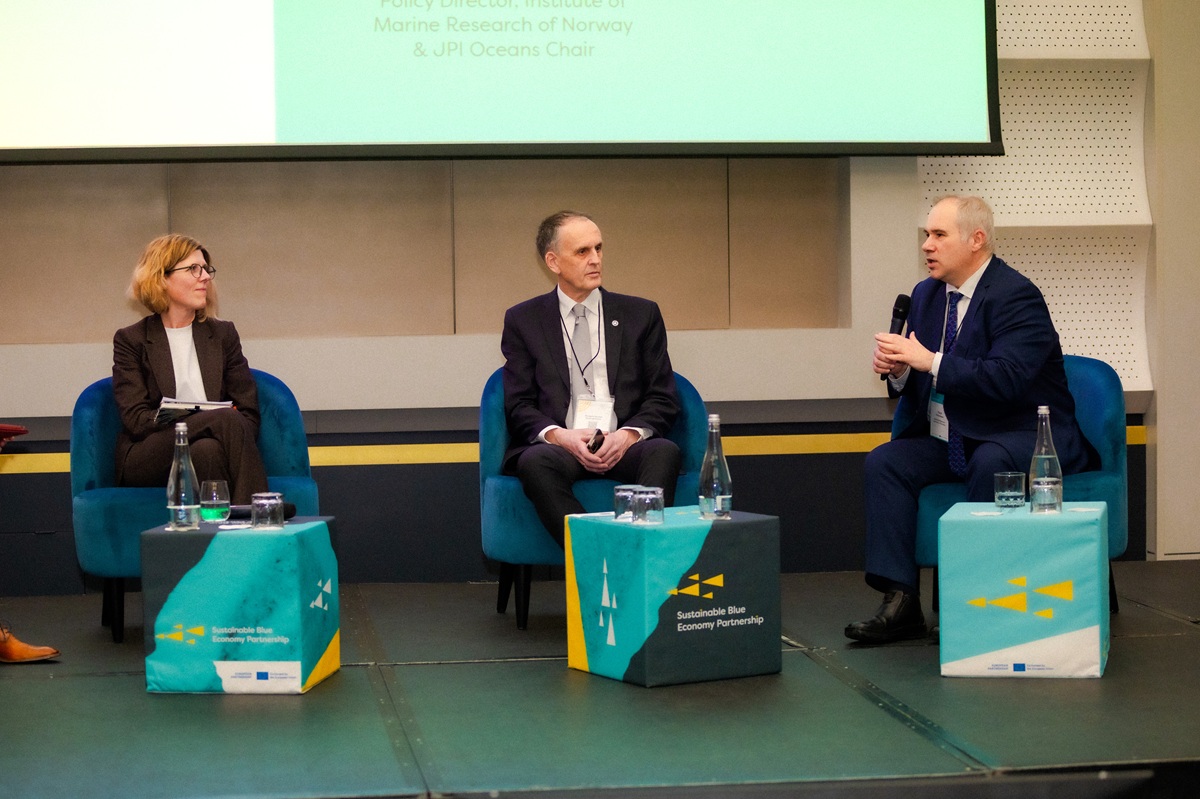
JPI Oceans’ institutional know-how was fundamental in Bucharest and embodied by its Chair Peter Haugan, who was invited to take part in a highly strategic roundtable alongside Wiebke Pankauke (DG RTD, European Commission) and Viorel Vulturescu (Romania’s research authority). Europe, argued Peter, must be “big enough, fast enough and innovative enough to be competitive,” and for that, European countries need a shared agenda and clearer common direction. The speakers concluded that ocean-related research, competitiveness, environment and security are now increasingly interconnected, and that Europe will need to think long-term if it intends to lead.
As the Sustainable Blue Economy Partnership moves towards its fourth joint call in 2026, the question is not only how many more projects will be funded, but how the knowledge they create will live on beyond this Partnership. The task ahead is to anchor their results into lasting structures and carry them forward into the next phase of European research and innovation, whatever form that may take.